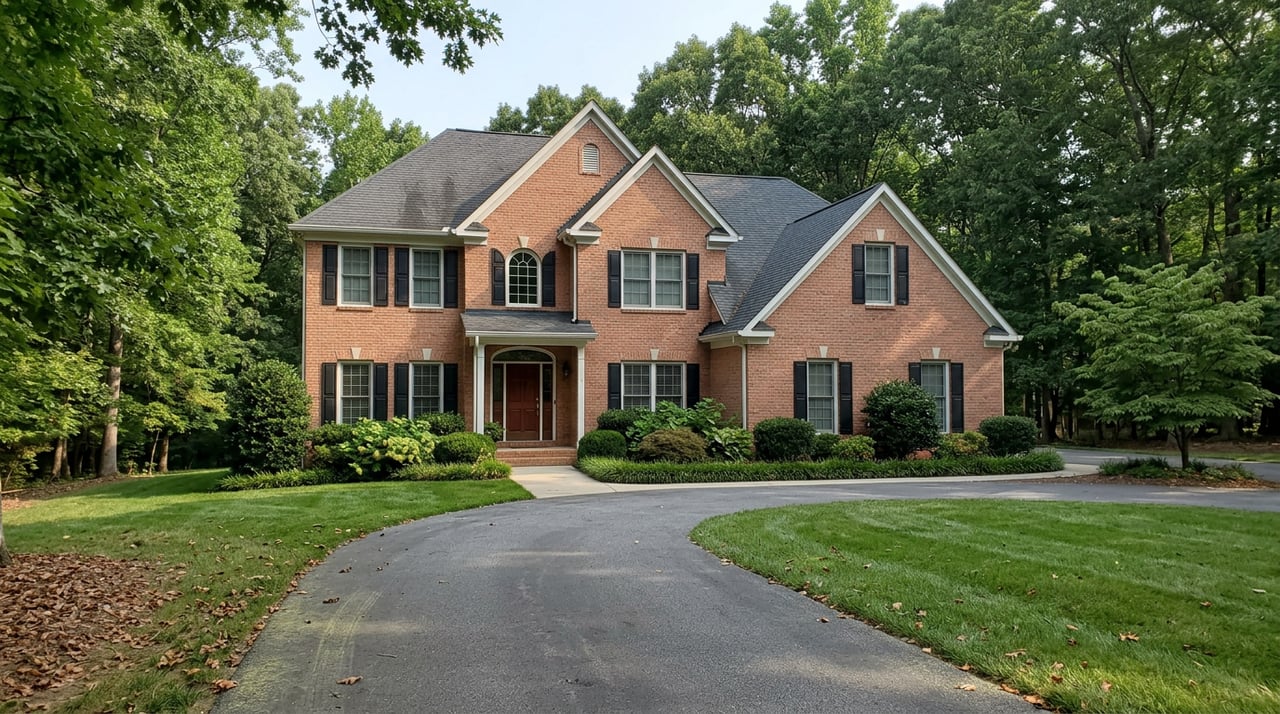
Pull up Milton on any national portal and you get one number: a median list price around $1.79 million as of July 2026, with homes sitting about 56 days on market and price per square foot down roughly 1% year over year. That is the number every buyer walks in with. It is also the number that hides the actual decision.
Because in Milton, the price is attached to a label called "acre," and the label is doing a lot of work. Two neighboring listings can both say "1.2 acres," carry similar finishes, and price within $50,000 of each other, and yet one of them can hold a pool, a detached garage, and a small barn while the other cannot legally hold any of those things. The gap sits inside the zoning code, and the code moved again this spring.
The question worth asking in Milton isn't "what does the median get me?" It's "what does this specific parcel let me do?"
The number the portals don't show
Roughly 25,000 acres of Milton, the vast majority of the city, sits inside a single zoning district called AG-1, Agricultural Residential. AG-1 sets a four-acre minimum lot size for newly created parcels and shapes almost every rural-feeling road you'll drive down when you tour. The intent is preservation of the estate character. The consequence for a buyer is that "acre" in Milton is not a raw measurement of what you can use.
A one-acre AG-1 parcel comes with a stack of subtractions before you get to your buildable footprint:
- A minimum lot width of 150 feet at the building line, expanded in 2022 from the 100 feet in place since incorporation, which restricts how narrow-and-deep parcels can be laid out and reduces room for pools, porches, and side additions on newer plats. Milton's council noted that expanding the minimum would mean the Board of Zoning Appeals should get fewer variance requests, since narrower lots tend to have less buildable space for extras like pool, porches and the like.
- A 100-foot setback from every property line for any structure that houses animals, which effectively rules out a barn or run-in shed on most sub-three-acre parcels.
- Stream buffers, tree save areas, septic drain field envelopes, and private well placement, each of which carves usable ground out of the technical lot size.
- Driveway length requirements on flag lots and rear parcels, which turn a chunk of the acre into pavement before you break ground on the house.
The practical result is that a 1.5-acre listing in one pocket of Milton can support the barn-and-paddock vision a buyer is picturing, and a 1.5-acre listing three miles away cannot. Same word. Different property.
What the April 2026 vote quietly changed
On April 13, 2026, the Milton City Council took up months of AG-1 code review and voted unanimously to lift a moratorium the city had placed in January on applications for minor subdivision plats under three acres. In the same session, they adopted eight amendments to the Unified Development Code covering lot coverage, natural areas, and minor plats.
Community Development and Public Works Director Sara Leaders described the review as a months-long process, explaining that the first month was spent really digging into the problem before we started looking at opportunities. The staff proposals were aimed at protecting existing landowners and preserving Milton's rural aesthetic, and the vote also unified the definition of "impervious cover" to close some ambiguity around gravel and hardened surfaces.
The council deferred one piece worth watching: the Agricultural Tract Exception, which would encourage preservation of large legacy land tracts (10 or more acres) by making it easier to maintain and divide adjacent 1-acre minimum lots over time. For a buyer eyeing a family compound or a legacy tract with the idea of eventually splitting off a lot for adult children, the deferral is the whole ballgame. One resident, Ben Kopacka, told the council that lot likely becomes too constrained, the way it's shaped and configured under the proposed rules. Former councilmember Julie Zahner Bailey pushed back on the timeline for public review of the volume of code changes.
If you are buying land in Milton in 2026 with subdivision or family-compound intent, the code you're relying on is not the code that was in force last summer, and part of it is still open. That belongs in your due diligence, not in a footnote at closing.
The arena math, in one table
If your reason for coming to Milton is horses, the AG-1 rules translate directly into how much land you actually need. The thresholds are specific enough that they should shape your search filters before your emotional filters.
| What you want | What the code generally requires |
|---|---|
| Uncovered riding ring | Allowed on residential parcels with added conditions in some cases |
| Covered arena | 5+ acres, with a use permit |
| Covered arena with lighting or seating | 10+ acres, with a use permit |
| Any building housing animals | 100 feet from every property line |
A five-stall barn, a small paddock, and a hobby ring can work on three usable acres. A covered arena so you can ride when it rains in November is a different property entirely, and a lighted arena for evening lessons is a different property still. When you see equestrian listings clustered around 3, 5, and 10 acres, that is not a coincidence. It is the code drawing lines.
For comparison, Alpharetta's public alternative is Wills Park Equestrian Center with a covered ring and 29 stalls on 50 rolling acres of fields and woods. That option changes the calculation for boarders. If you're willing to trailer to Wills Park or board at a facility like Mystique Dressage in Milton, you don't need to buy the ten acres. You need the three that hold a run-in shed and a paddock, and the price gap between those two tiers is where a lot of Milton buyers make their real decision.
Why the "median" is misleading here
Back to that $1.79 million July 2026 median list. The same month, price per square foot was flat to down about 1% year over year and median days on market sat at 56. Nationally that reads soft. In Milton it reads normal, because the top of the Milton market has always been thin and slow.
The estate tier, roughly $2.5 million and up, is a small pool of true horse farms and significant private acreage. Land alone commands a per-acre premium at that level, and the inventory is a handful of parcels at any given moment. A price shift on ten listings across a year is not a market trend. It is a rounding error inside a small sample.
What moves more predictably is the middle: well-appointed homes on one to three acres in the roughly $800,000 to $1.5 million range. That is where AG-1's rules matter most, because that is where buildable footprint varies most from lot to lot. Two homes at $1.2 million can carry the exact same MLS description and offer materially different lifestyles once you understand what each parcel can actually accommodate.
The 56-day days-on-market figure is doing something too. In a market where a large share of listings are custom estates on unique parcels, the "days on market" number is closer to a match-making timeline than a signal of weak demand. The right buyer for a specific ten-acre parcel is a small set of people. Finding them takes time. That is not a problem to price around. It is the shape of the market.
Before you write an offer
Here is the short list I give clients who are serious about a specific Milton parcel:
- Pull a zoning certification letter through the Milton CityView web portal. It costs $30 and it tells you what the city says the parcel is, not what a listing agent says it is.
- Order a current boundary survey showing easements, setbacks, floodplain lines, stream buffers, and any conservation easements or transfer-of-development-rights status. Conservation easements are permanent and shape resale.
- Map the buildable envelope with a builder or architect before removing due diligence, especially if a pool, barn, or detached structure is part of your plan.
- If the parcel is part of a legacy tract that a family is considering splitting, follow the deferred Agricultural Tract Exception. The rule that governs that split may not exist yet.
- Verify septic field location and well setbacks against your building plans. On sub-three-acre lots these can be the binding constraint, not the setbacks in the zoning code.
FAQ
Does AG-1 apply to homes in Crabapple or the denser Milton neighborhoods? Not the same way. Crabapple has its own form-based standards designed for a walkable village. AG-1 is the rural framework that covers most of the rest of the city. Always confirm the specific district before you write.
If I buy a legacy AG-1 tract, can I split off a lot for a family member? Sometimes, and the answer is actively being rewritten. The April 2026 vote lifted the earlier moratorium on minor plats under three acres, and the Agricultural Tract Exception designed for 10-plus-acre legacy tracts was deferred for further Planning Commission review. Confirm the current rule with the city before you assume a future split is possible.
Where do the numbers on horses per acre and stable size come from? Milton's zoning code and Unified Development Code set specific standards for minimum lot area per animal, setbacks, and manure management. Numbers you'll see in listing remarks are marketing. The code is what governs.
If you are looking at Milton because the pictures look like room to breathe, that instinct is right. Just make sure the specific parcel gives you room to breathe the way you want to live. When you're ready to compare two listings that look identical on paper and figure out which one actually fits your plans, One Nest Georgia will walk the parcel with you, pull the code, and price it against what it can actually do. Get your free home valuation and pre-listing consultation to start the conversation.